
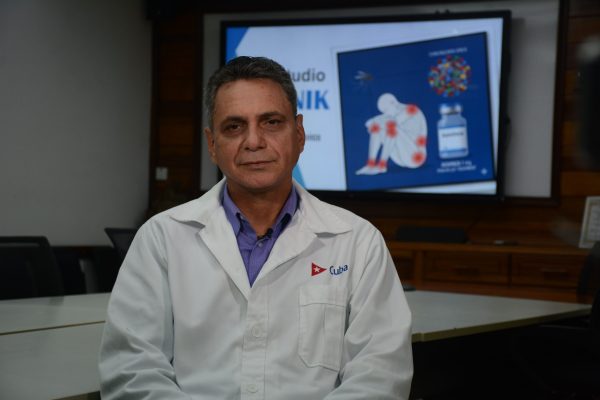
Interview with Dr. Julio Baldomero Hernández, Director of Clinical Research at CIGB
The two phase II clinical studies targeting patients recovering from Chikungunya virus infection, specifically those with residual arthritis in the post-acute and chronic stages, using the drug Jusvinza, were conducted with the aim of demonstrating the drug’s therapeutic effect and safety for this condition.
Both studies began on December 2, 2025. The study on patients in the post-acute stage of residual arthritis was conducted at the 10 de Octubre Clinical Surgical Teaching Hospital, which included 174 patients. And in the city of Matanzas, specifically at the Faustino Pérez Provincial Clinical Surgical Teaching Hospital, the study was conducted on patients in the chronic stage of the disease, which included 120 patients.
The final results of the clinical studies were ready at the beginning of April 2026. Both studies fulfilled the hypothesis we had proposed, meaning they resolved the patients’ issues, in this specific case the symptoms of pain and joint inflammation secondary to Chikungunya virus infection. We had anticipated that these results would be achieved in at least 70% of the patients. And it was demonstrated that Jusvinza is a safe and highly effective drug for this type of condition. In this regard, we can affirm that in Cuba we have a drug that reduces painful and joint symptoms, as well as secondary inflammation from the disease. This allows us to provide a better quality of life to our patients.
The high value of Jusvinza was demonstrated because we had set ourselves the goal not only of proving that it could be effective in treating painful and inflammatory clinical manifestations, but also that, once these symptoms were resolved, the treatment could have a lasting effect over time. That is, we treated patients for 8 weeks with a regimen of 6 doses of Jusvinza and with a regimen of 9 doses of Jusvinza. Both regimens were very effective. We also conducted an evaluation at week 12, which showed that the drug’s effect was maintained over time.
It is known that there are many treatments where, even if the patient temporarily resolves the symptoms, a relapse of the disease occurs. With the use of Jusvinza, we have demonstrated not only that the drug is effective and capable of resolving joint symptoms, but also that the effect persists and, therefore, patients do not progress to the chronic form. Undoubtedly, this is an advantage that makes it very attractive; but it also offers a guarantee to medical personnel and also provides peace of mind to the population, by having a highly effective drug available.
To position the drug for this disease, it was necessary to conduct a phase III clinical study, which has been approved by the regulatory authorities. At this moment, that clinical study is in its second week of execution, with a total of 300 patients, and it is being carried out at two sites in Havana; specifically at the 10 de Octubre Clinical Surgical Teaching Hospital and at Clinic 1 in La Lisa. We are hopeful and very optimistic that the results being observed will replicate the results of the two phase II clinical studies.
I reiterate to you, Cuba today undoubtedly has a highly effective drug. In the two clinical studies, in addition to Jusvinza, we used conventional therapy for the disease, specifically anti-inflammatories, analgesics, steroids, and disease-modifying agents, which is the therapy used worldwide. And I repeat, this Cuban drug, Jusvinza, is a highly effective therapy.