
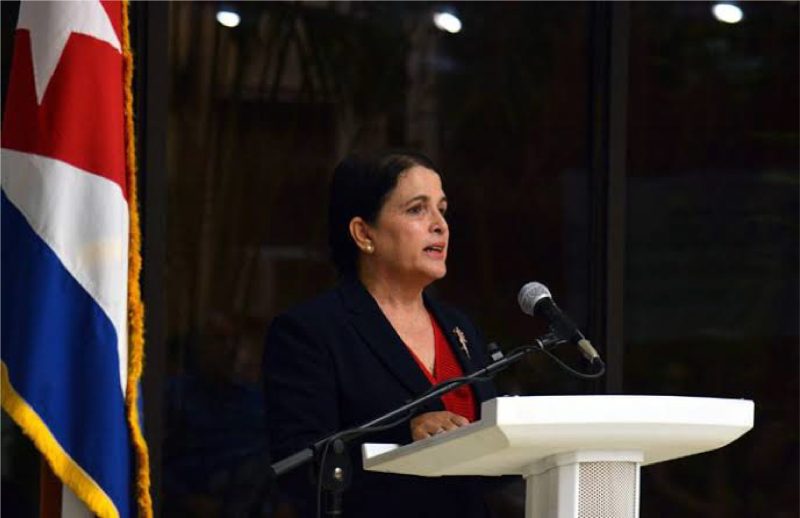
Dear Comrade Miguel Díaz-Canel Bermúdez, First Secretary of the Central Committee of the Communist Party of Cuba and President of the Republic of Cuba
Dear Comrade Manuel Marrero Cruz, Member of the Political Bureau and Prime Minister of the Republic of Cuba
Dear members of the presidium
Colleagues:
Allow me to begin my words by greeting and thanking Professors Limonta, Luis Herrera, and Pentón; the families of Professors Victoria, Barcelona, Angelito, and López Saura; and the founders of the CIGB who are here present, representing a group that devoted themselves and made it possible for Cuba to join early on the Revolution in the field of genetic engineering and modern biotechnology worldwide.
Today, as we review the words of Commander-in-Chief Fidel Castro Ruz in his inaugural speech at the Center on July 1, 1986—and we have been doing so through our communication campaign “Fidel said…”—we are amazed by how much wisdom, how much willpower, and how many results were achieved by turning ideas into facts.
Fidel left us a great legacy in his inaugural speech and in every visit and exchange he had with CIGB workers. His visits incubated the conception, reviewed the construction, showed the world what we were capable of, including celebrating a Father’s Day in our cafeteria. They always brought information, guidance, and conveyed the trust he had in us. Recognizing him time and again, especially this year as we celebrate the centenary of his birth, honors us and fills us with pride.
We will never overlook those first steps toward having a laboratory to produce leukocyte interferon alfa-2b, starting with the conditioning of a protocol house—the 45th anniversary of which we also celebrated last May 28. While the selected scientists were preparing to master the technology and learn about the clinical trials being conducted, others focused on preparing the site that would host the feat of producing Cuban interferon by Cubans. And they succeeded! And there was the Commander, attentive to every detail.
Thus, the path begun opened great avenues, where trained personnel from different disciplines gradually gathered around the work that was taking shape, and in 1982 the Center for Biological Research was founded, which served as a pretext to keep dreaming.
In about two years (between 1984 and 1986), the CIGB was built and inaugurated by Fidel on July 1, 1986. It was a rainy afternoon that did not prevent foreign guests, scientific and political figures, as well as experienced workers, new recruits, and even students, from witnessing a historic moment that would place Cuba at the forefront of genetic engineering and global biotechnology. Fidel’s words on that July afternoon became embedded in every corner of this center and extended to the centers that emerged later. His guerrilla boots echo through our hallways!
Many joined this new center, and the core that would later occupy the CIGB’s laboratories and production plants continued to grow. Some of them are no longer physically among us, and we also dedicate this tribute to them. Each one, from their profession or trade, gave their best: their dedication and example are present in this great work.
And the CIGB family continued to grow across the national territory, with its institutions in Camagüey in 1989, Sancti Spíritus in 1990, the Heber Biotec enterprise in 1991, and more recently, our sibling, the CIGB Mariel Biotechnological Industrial Complex, promoted and inaugurated by Army General Raúl Castro Ruz on November 5, 2021. Through the development of different business models, we are also present with enterprises and R&D centers in other countries.
Until the first decade of the 21st century, we were part of the Western Havana Scientific Pole, and since 2012, we have been part of the BioCubaFarma family, now as an enterprise.
Undoubtedly, this entire evolution was preceded by a vast history of human capital formation and the promotion of the country’s scientific development. The thinking of Commander-in-Chief Fidel Castro Ruz, expressed on January 15, 1960, that “The future of our Homeland must necessarily be a future of men of science,” and the literacy campaign of 1961, marked the beginning of strategic actions of great significance for the development of science in Cuba, and especially in the biopharmaceutical sector.
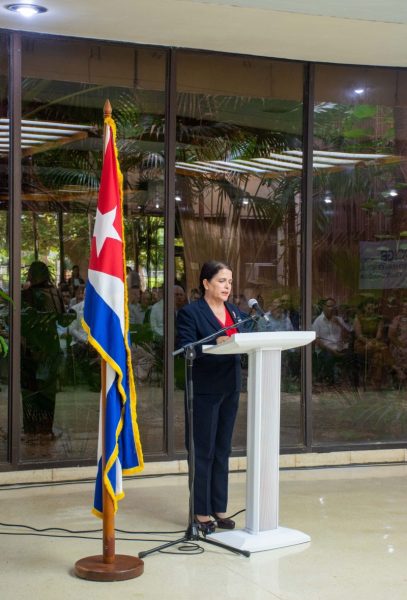
Colleagues:
Great have been the challenges throughout these years, great have been the results, and the workers and managers of the CIGB are witnesses to them. Here are its directors and other comrades who have taken on important responsibilities in our country.
It fills us with pride and commitment to have always had, at every stage and in every cycle of evolution, the leadership of Fidel, Raúl, and Díaz-Canel.
What we learned and mastered over more than 30 years—developing preventive vaccines, medicines, and diagnostic systems for human, animal, and plant health—paved the way for us to say “yes” when faced with the health situation posed by COVID-19.
At that moment, during the pandemic, everything we had accumulated in terms of work systems, knowledge, technology use, and management of production systems was put into service for the health of our people. We once again manufactured innovative vaccines like Abdala, and medicines to prevent and save lives like Jusvinza and Nasalferon, among others. It was then that we understood with greater certainty how pertinent those large investments deployed around the Scientific Pole and other institutions during the 1990s, in the midst of the Special Period, truly were. These projects, driven by Fidel, which seemed colossal, were there in the 21st century providing the response that the country needed in the face of a complex and unknown global health situation.
Those were difficult times, the days of COVID-19, but they brought great reward, because we had the leadership of the First Secretary of the PCC over the committee of experts and scientists, the support of all institutions, agencies, and entities, and the affection of the Cuban people, who recognized us to the point of moving us to tears with their words and gestures.
Today, 40 years after the inauguration of the CIGB, and within the framework of the centenary of our Commander-in-Chief’s birth, we celebrate this event in a context where the energy, financial, and commercial blockade imposed by the United States government on Cuba has intensified to limits never before experienced.
This blockade affects the mission of our sector in all its scope, including the commitment to the health of our people.
In the face of this scenario, the CIGB has a collective of workers willing and committed to innovate, not only in the most modern genetic engineering and biotechnology techniques, but also in business management.
As a socialist state enterprise with high-technology status, we are evaluating, in order to implement and put into practice, the economic and social transformations recently approved in our country. We are a sector with great capacity for innovation and adaptation, with a desire to work and achieve results that contribute to generating greater wealth for the Cuban people.
I want to thank, on behalf of all CIGB workers, everyone who has sent us messages of congratulations and encouragement to continue our work. To those who traveled and are here with us; to those who made possible that first batch of interferon; to the professors and the young people who followed them, which is why they are celebrating 40 years and more. To those who, having reached retirement age, have decided to continue contributing through rehiring. To the representatives of workers and young people of the CIGB, in this hall and in other halls following this event.
Our commitment is that the CIGB will continue to be a great center where great results are obtained, as Fidel asked of us, and to remain faithful to this idea, as Díaz-Canel told us on June 21, 2021, upon the announcement of the efficacy of Abdala as an anti-COVID-19 vaccine.
Congratulations to all CIGB workers and thank you for being here! Thank you very much!